By Overdrive Services · Fleet Manager France / Luxembourg, independent broker · September 2026.
ARTICLE 2 · PRACTICAL GUIDE ELECTRIC TRANSITION - SEPTEMBER 2026
Switching to Electric Vehicles: Are You the Right Candidate?
Electric vehicles (EVs) offer a genuine financial advantage over their useful life, provided the vehicle is driven enough. But mileage alone isn't the whole story. Your drivers' habits and daily travel patterns also have to fit how an EV actually works. This guide helps you assess, concretely, whether electrification is right for your fleet: real-world range, day-to-day charging, verified running costs. For the full financial comparison and TCO calculation, see our other articles.
1. What people often forget about the electric vehicle
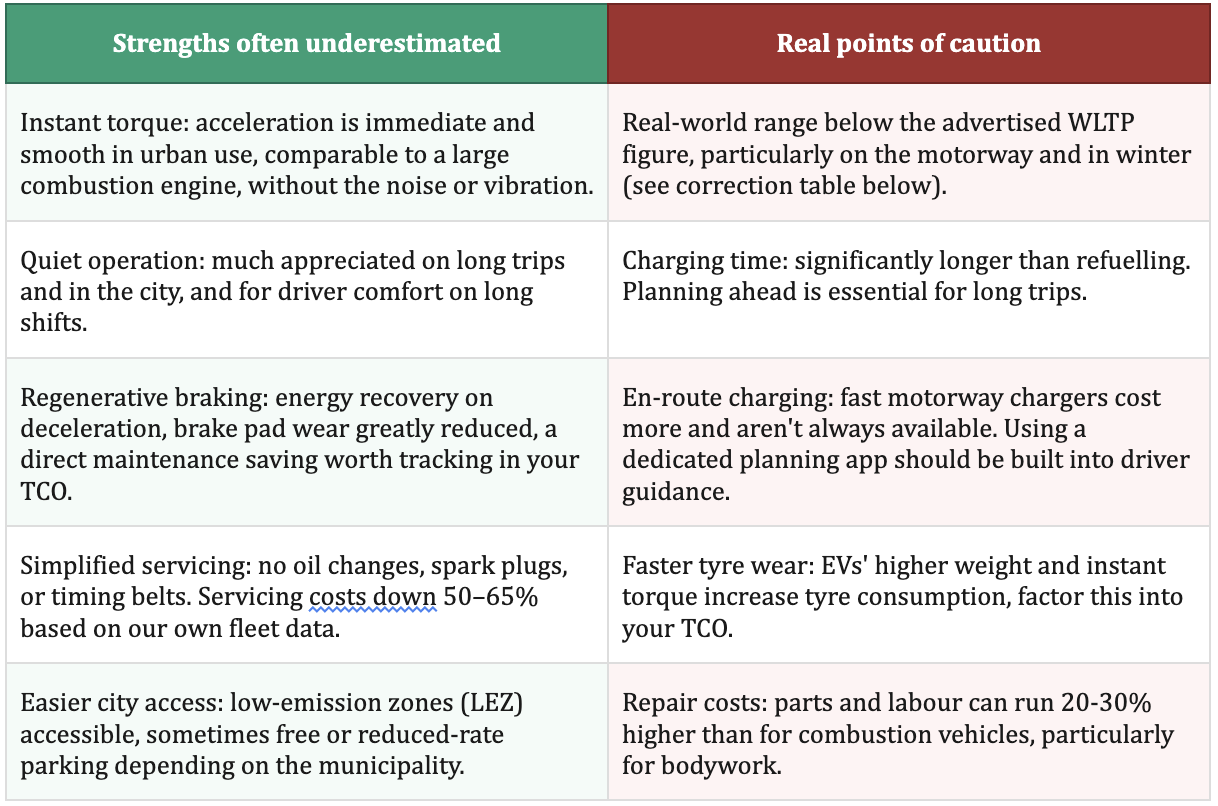
Range and charging time are the arguments most commonly raised against EVs, and they deserve to be taken seriously. But drivers who have made the switch consistently point to advantages that aren't obvious until you've actually run the vehicles:
2. Calculating real-world range: don't rely on WLTP
The European WLTP standard (Worldwide Harmonised Light Vehicle Test Procedure) is measured in laboratory conditions: controlled temperature, no wind, moderate and constant speed, air conditioning off. In real-world conditions, range is consistently lower. Here are the correction coefficients we use at Overdrive to advise our clients:
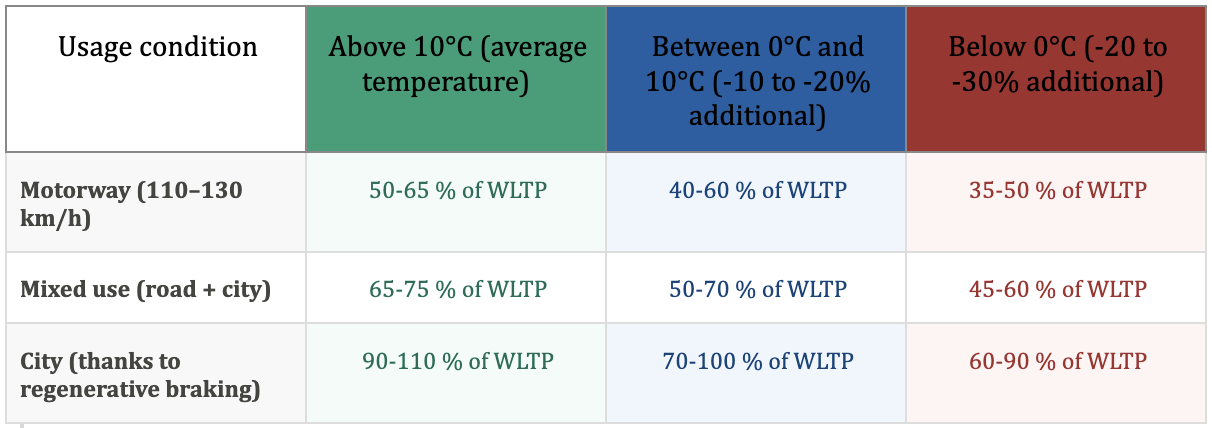
Note: these coefficients are ranges representing typical conditions. Real-world range also depends on exact speed, battery condition, use of heating/air conditioning, and driving style.
3. Charging day to day: changing habits
Charge regularly, not only when the battery is empty
With a combustion vehicle, drivers wait until the tank is nearly empty before refuelling. With an EV, the logic is reversed: charge whenever the opportunity arises, ideally every night at home or depot charger. An EV battery performs better and lasts longer when full discharge cycles are avoided. Most manufacturers recommend keeping charge between 20% and 80% for daily use.
Technical note - Charging to 100% regularly accelerates battery ageing on certain models. Check the vehicle manual: most manufacturers offer a charge limit mode set to 80% for daily use, reserving 100% charges for long trips. As a result, for your daily trips, it is advisable to charge more often and never to 100%.
Home charging: the essential condition for low cost:
To keep running costs attractive, home charging is the top priority. It accounts for 80–90% of charging sessions for drivers who have access to it. The table below shows verified costs as of September 2026:
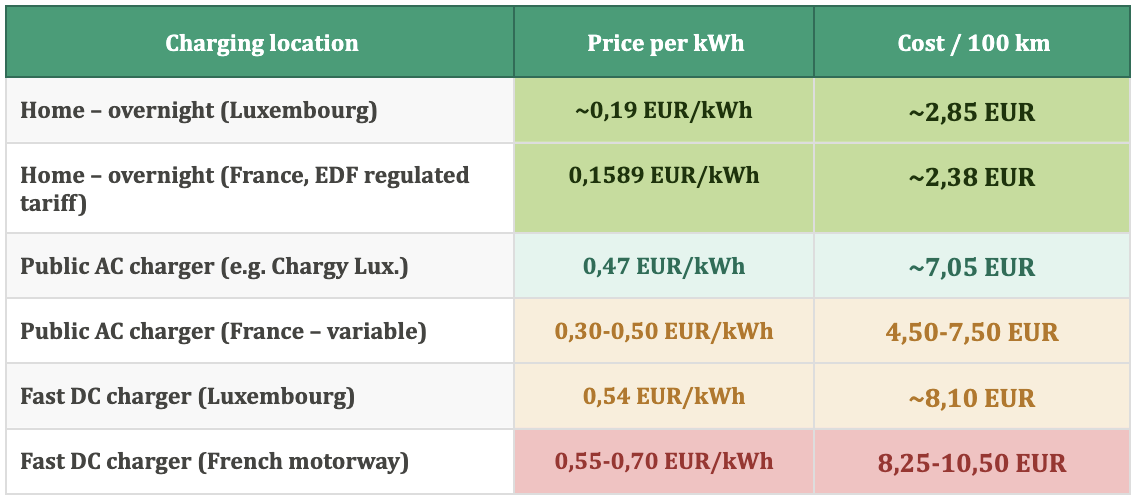
Base: average consumption of 15 kWh/100 km
Confirmed sources: Luxembourg home ~€0.19/kWh (ILR / Switchr.lu, 2026) · France home €0.1589/kWh (EDF regulated tariff, off-peak option, in effect since 1 August 2026) · Chargy AC €0.47/kWh & SuperChargy DC €0.54/kWh (Chargy.lu, in effect since April 2026). Tariffs verified September 2026. French ranges: operator pricing (Ionity, Recharge, Tesla), no unified national fee.
Planning for motorway stops
Driving electric on long trips means accepting more frequent and longer charging stops than a fuel fill-up. A fast charge from 20% to 80% generally takes 20 to 40 minutes at a DC charger, depending on the maximum charging power accepted by the vehicle. This is not an insurmountable constraint, it's a habit to adopt. Planning apps (ABRP, Chargemap, A Better Route Planner) let you anticipate stops and identify available chargers along the route.
4. Optimising your consumption: driving style makes the difference
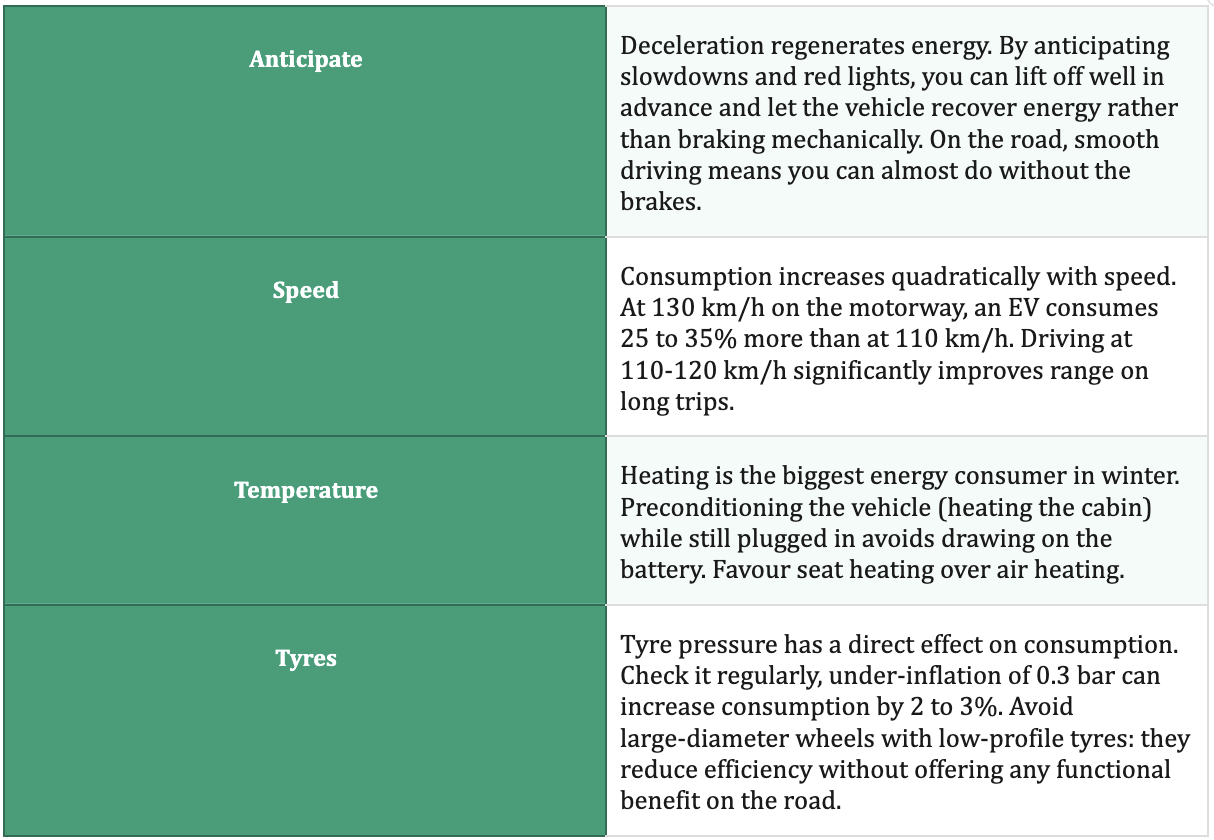
The electric vehicle is far more sensitive to driving style than its combustion equivalent. A few simple habits help preserve range and reduce costs:
5. Your profile: are you a good candidate for electric?
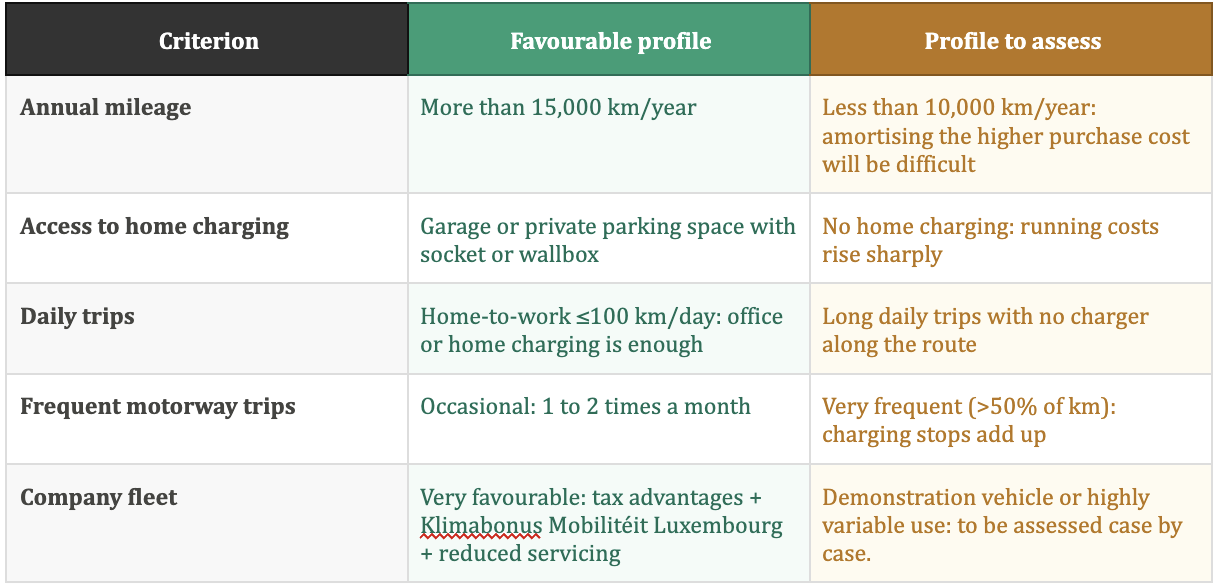
Not every profile gets the same benefit from an electric vehicle. Here is a quick-reference grid to assess whether your situation is favourable:
Overdrive advice: As an independent broker, we carry out a personalised profile audit before recommending any vehicle. Mileage, daily trips, charging access, taxation: every parameter counts. Contact us before you commit.
Conclusion: Electric yes, but for the right profile !
The electric vehicle is not universal. It offers a real financial advantage and a genuinely pleasant driving experience, provided you drive enough, charge mainly at home, and accept a few changes in habits on long trips. If your profile fits, the financial advantages in 2026 are considerable.
If you have doubts about your profile or your usage, that is precisely our role as an independent broker: to help you decide, with no bias toward any brand or technology.
Read our article published in May 2026: Electric or Petrol in 2026: the practical guide for Luxembourg & France (costs, incentives, TCO)
Still not sure? Let's talk about your profile.
Overdrive is an independent broker: we don't sell any brand. We analyse your mileage, your travel habits and your taxation to recommend the objectively lowest-cost solution.
Overdrive · Fleet manager France / Luxembourg, independent broker · Practical Guide Article - September 2026